
Most people research facial procedures one at a time: a facelift page, an eyelid page, a neck page. But faces age as a unit, so the smartest plans treat them that way. Combining the right procedures means one anesthesia, one recovery, and results that match across the face and neck. The skill is knowing which combinations make anatomical sense.
Which combinations actually make sense
Facelift and neck lift are the classic pair. The SMAS layer of the face continues into the platysma muscle of the neck, so lifting the face without addressing the neck, or the reverse, leaves a visible mismatch. They are routinely done together. [1]
Facelift and blepharoplasty pair well for the same reason: a lifted jawline next to tired, hooded eyes reads as unfinished. Doing both in one session keeps the whole face on the same timeline. [1]
Rhinoplasty and chin augmentation are the "profile makeover." A recessed chin makes the nose look larger than it is, so balancing the chin can change how the nose reads without touching it further. [1] Chin work is straightforward: a small incision under the chin or inside the mouth, minimal visible scarring, back to work in about a week, full contour in 1 to 3 months, and a permanent result. The implant can be removed or revised if ever needed. Risks run the standard small set: infection, the implant shifting, temporary lower-lip numbness, and in rare cases extrusion.
One more combination gaining ground: deep plane facelift with fat grafting. Rapid weight loss hollows the face as well as loosening it, and surgeons are seeing more of these cases as GLP-1 use grows. Grafting your own fat restores volume while the lift restores position, in the same operation.
Why one recovery beats two
Every surgery carries its own anesthesia, its own swelling curve, its own weeks off work. Combine thoughtfully and you pay those costs once. You heal once: the bruising, the sleeping elevated, the social downtime, all in a single stretch instead of two. The surgeon also plans the face as one composition, rather than fixing one area and matching the second to it later.
The mini-facelift trap
The mini facelift is marketed as the sensible middle ground: shorter incisions, quicker recovery. For the right patient, early mild laxity with no neck involvement, it can be fine.
The trap is choosing it for the wrong anatomy. A mini lift is a skin-only pull. It cannot correct midface descent or real neck laxity. Patients who needed a full facelift and got a mini instead end up going through surgery twice: once for the mini, once for the revision that does the job properly. If a consultation steers you toward a mini despite significant jowls or neck bands, get a second opinion.
The neck-lift-alone caveat
A related mistake: lifting only the neck when the jowls sit above the jawline. A neck lift tightens what is below the jaw, but jowls are a face problem. Tighten the neck alone and the untouched jowls can look heavier by comparison.
A neck lift on its own makes sense when aging is concentrated in the neck: loose skin, platysmal bands, fullness under the chin, a jawline softening from below. The operation runs 2 to 3 hours under general anesthesia or IV sedation. The work itself usually combines platysmaplasty, tightening the neck muscle, with cervicoplasty for the skin, often plus a little neck liposuction. Expect swelling and bruising for 1 to 2 weeks, desk work in 10 to 14 days, a compression garment, and no strenuous exercise for 4 to 6 weeks. Results settle over 2 to 3 months and typically last many years. [1]
Staging: when one surgery now and one later is smarter
Not everyone does everything at once, and that can be the right call for recovery time or caution. The rule for staging is to follow anatomy.
Do the structurally foundational work first. Brow position gets assessed before upper eyelid surgery, because a low brow changes what the lids need. The face and neck get planned together, because the SMAS and platysma are one continuous layer, which is why a neck lift alone is rarely the first move when the jowls need attention. And when the nose and chin are both on the table, evaluate them together, since chin projection changes how the nose reads.
What you want to avoid is the backward sequence: a procedure that removes options later. The classic example is a skin-only mini lift done years before a proper facelift becomes necessary, leaving less tissue to work with the second time.
How a specialist sequences the plan
Good planning follows anatomy, not a menu. Brow before lids. Chin evaluated alongside the nose. Neck planned with the face. Each decision sets up the next one.
That sequencing is the real value of a consultation. A specialist maps your face and neck as one unit, tells you what to do together, what to stage, and just as importantly, what you do not need.
Frequently asked questions
Can I combine a facelift and a neck lift in one operation?
Yes, for well-screened patients. They are the classic pair because the SMAS layer of the face continues into the neck's platysma muscle. A neck lift alone runs 2 to 3 hours under general anesthesia or IV sedation, and results typically last many years.
How does a mini facelift compare to a full one?
A mini is a smaller operation: shorter incisions, quicker recovery. But it only helps if you are the right candidate: a mini is a skin-only pull that cannot fix midface descent or real neck laxity.
How long is recovery when procedures are combined?
Plan on swelling and bruising for 1 to 2 weeks, desk work in 10 to 14 days, and no strenuous exercise for 4 to 6 weeks. Combining does not double the downtime. You heal once, in a single stretch.
How long will the results last?
A neck lift typically lasts many years with stable weight. A chin implant is permanent, and it can be removed or revised if ever needed.
Can I just do one small procedure, like my chin?
Absolutely. Not everything needs combining. Chin augmentation is straightforward: back to work in about a week, full contour in 1 to 3 months. The key is sequencing. Evaluate the chin alongside the nose, since chin projection changes how the nose reads.
A consultation at Nip Tuck Aesthetics in Miami is where that plan gets drawn. Bring your questions and your timeline. Leave with a sequence that makes sense for your anatomy, not a list of procedures. Nip Tuck Aesthetics, 8501 SW 124 Ave Suite #317, Miami, FL 33183. Book a consultation and start with a plan built around your face.




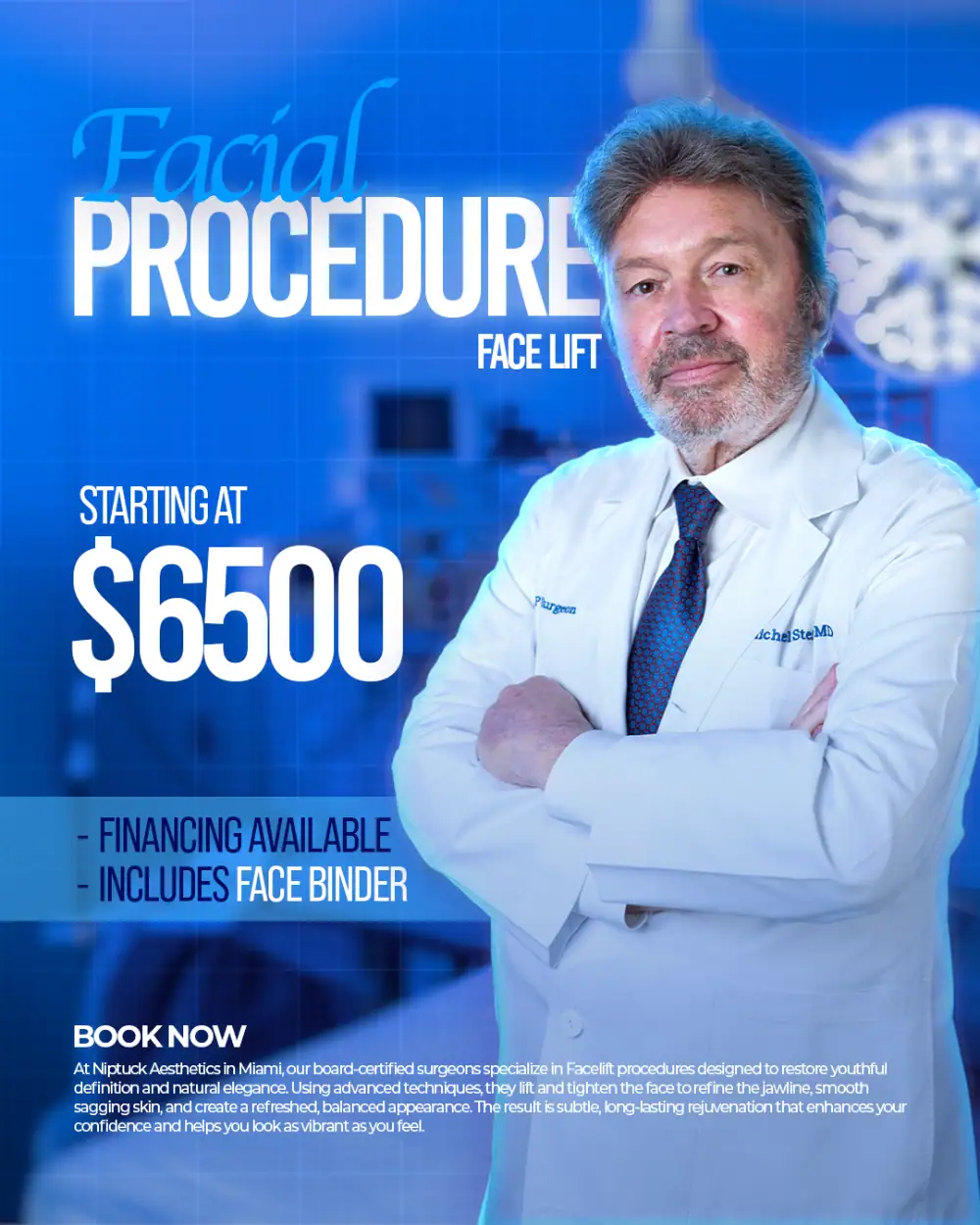
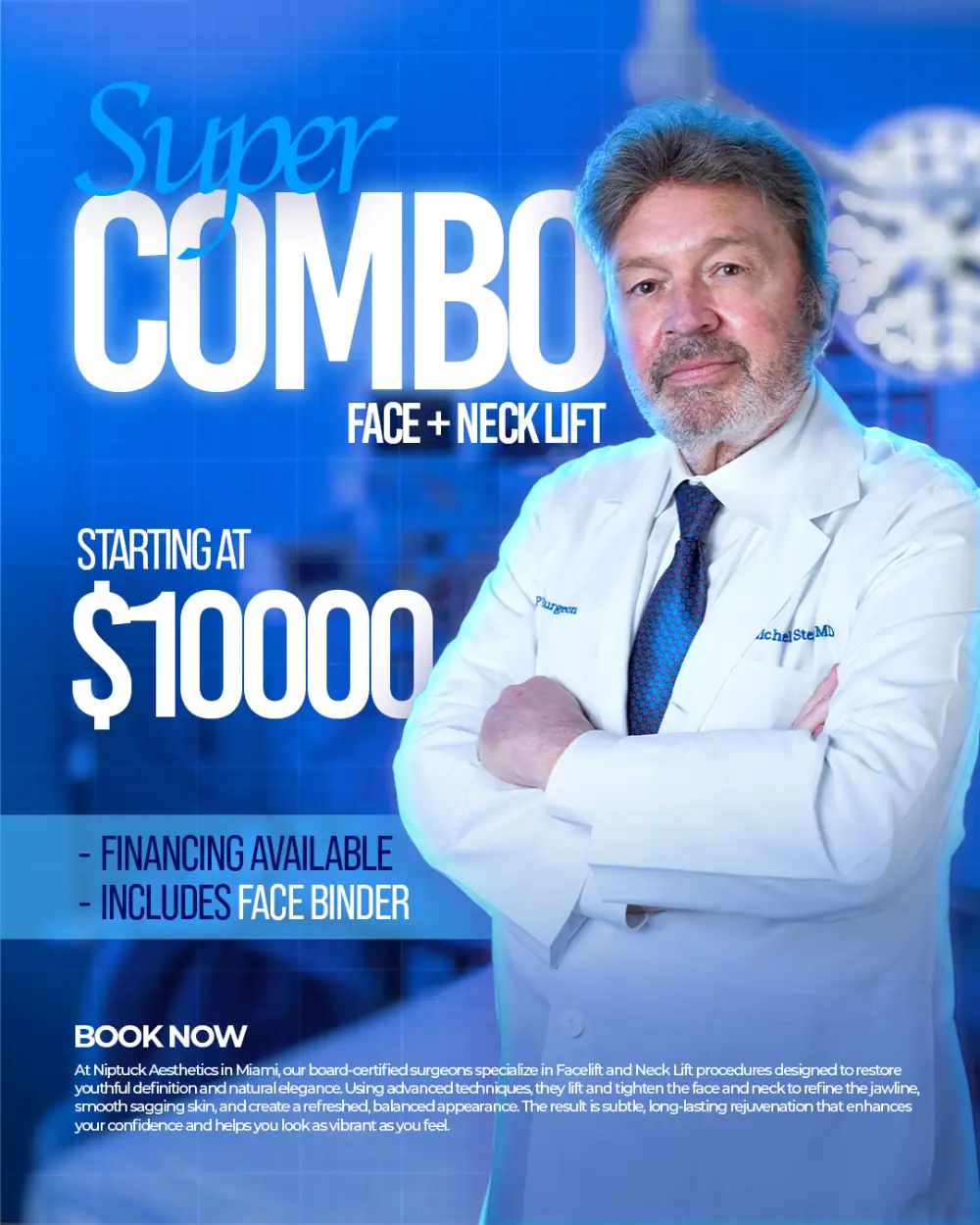



 FINANCING AVAILABLE -